Saturday, November 19, 2011

Going Through to the Next Round


by Doug Roland

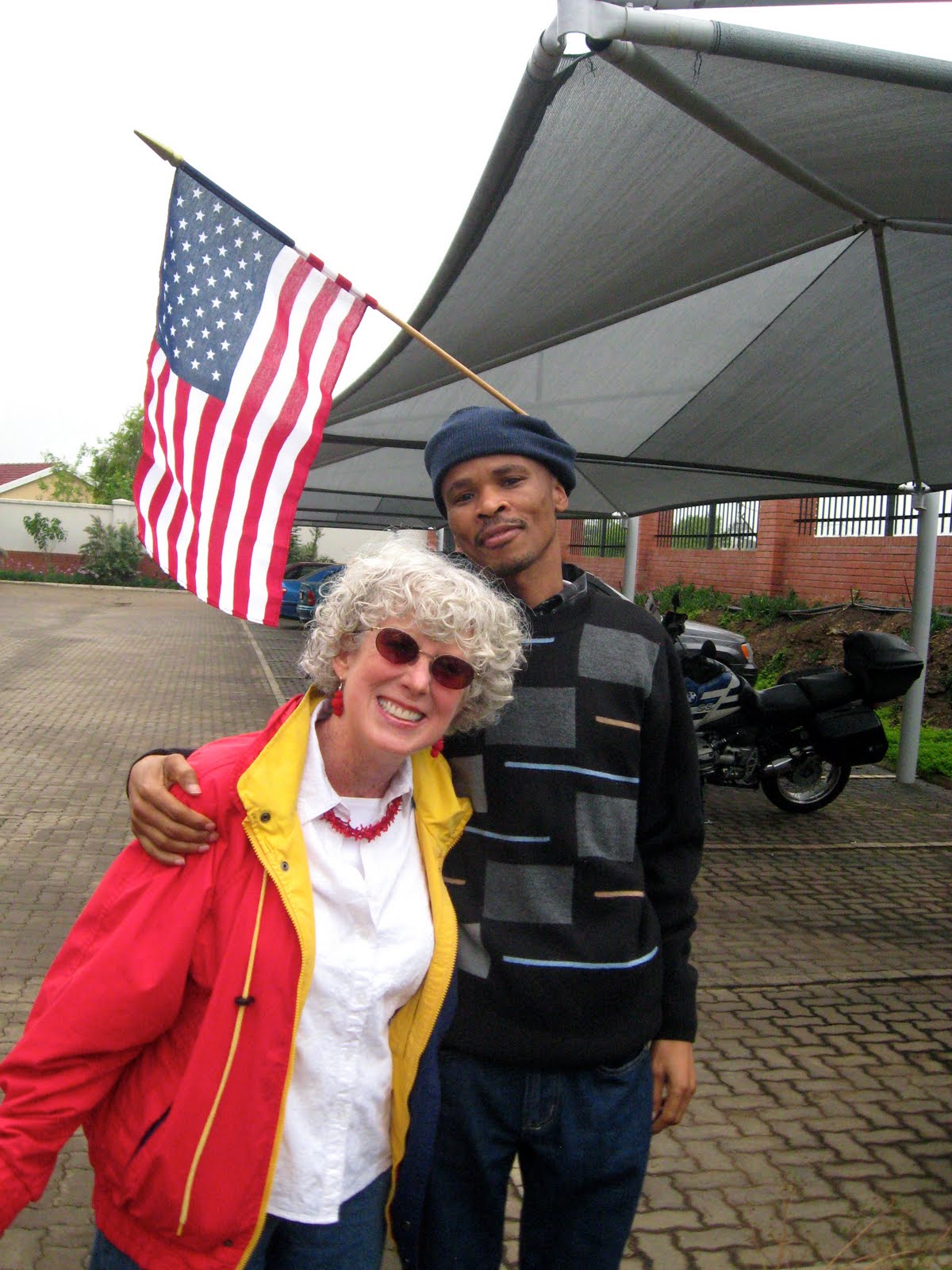
A couple of days ago, I was in a conversation about lemon cake, a long-time favorite of the family. Problem was that I couldn't remember the name for those little shavings from the lemon rind. As well I find it hard to recall the names of people I know back home. In addition to recipes and people, common words fall out of our vocabulary and new ones have taken their place. For example, "yuk" is replaced with "eish", and "too bad" with "ach shame". There is a shift in the way we live and relate to others. It has played with our memories and pushed us off our personal center of gravity. There's a word for this - acculturation.


Before coming to South Africa, we read several books by Peace Corps volunteers who agreed that it took a year before you could begin to make a difference. For us, it has taken 15 months, but, as you know, we are old and things happen slowly. The signs that this was happening began popping up over the last 2-3 weeks. As we finish the year, we are getting some direct and indirect messages from seminarians that, despite their initial perception that we are Americans who have no clue but have an agenda, we are ok. While we could give many examples, one is that Cheri's consultations as nurse have gone from 2-3 per week to 2-3 per day - all this in a culture that looks at modern medicine with suspicion.


This respect has been earned and it wasn't easy. It has come from from the fact that we treat everyone the same. We are demanding and consistent in evaluating the work the seminarians do in our program. We don't accept many excuses. Yet, we are quick to affirm when their work is good, or when they are working their way out of bad habits. Without knowing it, we began speaking to them in a language that could be understood and trusted. In this or any country, state or province, it is the predicate to making a positive difference in the lives of others.

Trust is a hallowed word. It is an intangible that lies at the basis of any society, whether it is China or an African village. Making a difference in someone's life comes via trust. It doesn't always happen, but through God's grace, the opportunity is now for real.


First a long Christmas break in Tampa, then back to South Africa for the second round.


At this season of giving, we invite you to participate in this effort. We promise that this will be done only one more year. Ideally, we want you to come here, visit and gain understanding. If that is not feasible, you can help through your prayers, e-mails to either of us at dcroland@gmail.com, or by making a tax-deductible contribution as follows:


Hyde Park United Methodist Church

500 W. Platt St.

Tampa, FL 33606

Designate for Seth Mokitimi Methodist Seminary/Roland

Be sure to include your address for a letter from the church confirming receipt of a donation.


Wednesday, November 2, 2011

INVITATION


by Doug Roland


Last Tuesday morning, I saw her negotiating the doorway into the reception area. With a metal crutch on each arm, she fought through the opening as if it were a life and death matter. It was obvious that she was badly crippled. Who was she, I wondered? But, I had work to do and couldn't be bothered. We have visitors all the time.


There is a communion service on Tuesday evenings open to anyone who would like to come. As we walked the path to the chapel, there was a young boy, about 11 or 12, sitting at the top of the long slope, wearing a big smile of welcome. He greeted us and we replied. It wasn't one of the seminary children but we assumed he was there for some reason.


Each chapel service begins with singing, then some prayers and other readings. After that, the speaker or minister for the evening is asked to come up to the pulpit, usually a non-event. This time there was a buzz.


Looking through the rows of chairs in front of me I could see that the crippled woman was being helped up the two steps to the chancel. The chapel congregation quieted. Now alone, she carefully placed herself behind the pulpit, properly aligned with the microphone, and once she achieved the balance she wanted, faced the congregation and smiled. Her face was bright, warm and radiant in a way that could be felt throughout the chapel. Applause broke out before a word was uttered, so impressive was her journey up the steps. In many ways words were unnecessary.


There is a famous photograph of Tenzing Norgay, a common sherpa from Nepal, hired by Sir Edmund Hillary. The photo captures the moment they reached the summit of Mt. Everest, the first people to do so. Norgay's smile is as bright as the snow, a single gesture that reflected the completion of a task never done before in the face of unbelievable odds. The lady's smile reminded me of that photo.


She was here as a friend of one of our staff members, an African from Zambia, and was asked to deliver the message - her unique and compelling story, a living testimony of a person who is using her disability to throw a bright light into a dark corner.


For her sermon she selected Luke Ch. 19:37-40. It tells of Jesus' entry into Jerusalem as the disciples shouted out praises to God. Some Pharisees said to Jesus, "Teacher, rebuke your disciples." "I tell you," he replied, "if they keep quiet, the stones will cry out."


Born in and a citizen of the Democratic Republic of the Congo, Micheline Kamba contracted polio at a very young age. The people in her village named her "Unlucky". Her mother would have none of it, and changed her name to "Lucky". Any notion that her daughter would be an outcast, condemned to a life of immobile solitude, was not acceptable to her.


When Micheline was old enough to understand her limitations, she asked her mother how she would ever get along in this world. The response was, "the stones will cry out". No disability would silence her daughter.


Bolstered by the prayers of her father and mother, Micheline started school, slinging her crippled legs into the classrooms. She loved learning and dreamed of finishing school. She hoped against all odds that she would be married. She was told that she would never have children. Her parents remained undeterred. "The stones will cry out."


She finished high school. The right man entered her life and they married. Four years later, she gave birth to the boy who greeted us outside as we were coming in. She entered the ministry and was ordained in the Presbyterian church. At each juncture, he parents proclaimed, "the stones will cry out."


Micheline's church did not permit her to serve communion, saying that it was awkward and people would be uncomfortable. She had no use of her right arm so would have to serve with her left hand, something that has negative connotations in many cultures. And they (the "church") did not like the idea of using a wheelchair.


Her "sermon" was her story and her mother's. One could barely listen to it without tears, so affirming and positive was her message. Surely if she can bear her own cross with such grace and enthusiasm, then we are left with empty excuses. When she finished, she faced her twisted body to the left, heaved herself up, and step by step willed herself to a chair at the side of the chancel. There she sat and rested.


The communion service was led by the Dean, but before he started, he was so moved by the sermon that he picked up the microphone and shouted several times in true African style, "The rocks will cry out!!" "The rocks will cry out!!" as if to sear it on our eardrums and our hearts. He returned to the communion table and began the liturgy. Soon he paused, looked to his left and invited Micheline to join him at the table to assist in serving communion. This simple invitation opened a door long locked for her. She rose up out of her chair with renewed strength and indomitable determination and made her path to the table. A tray full of communion elements was handed to her. She served communion for the first time in her life. Those near her said she was speechless, her eyes filled with tears. And so too were the eyes of the congregation. We had witnessed the transformation of Jesus' reply to the Pharisees when bold words became a tangible reality. It began with an easy gesture, a simple invitation.

Tuesday, October 18, 2011

"Rounding Third and Headin' for Home" -- Joe Nuxhall


It's that time again when the seminary makes a frantic dash to the end of the semester, preparing, giving and grading final papers, exams, reports, entering test scores and absences, tackling the procrastination pile, and making a final assessment of those who will leave us to make sure they are ready. There's also a sprinkling of special events:


a. Heritage Day when seminarians celebrate their respective cultures in song, dance and skits. They represent nine cultural groups throughout the country.

b. Sports Day - most of one Saturday with competitions in volley ball, netball and soccer.


c. Parties for departing staff members - the librarian and her husband (an adjunct at the seminary) moving north to be nature conservation manager and chaplain to a private school, respectively; the bookkeeper, who has been here since day one of the seminary, and her husband are emigrating to the United States.


d. A ceremony honoring those who have completed their studies and other obligations here as they go off to their new lives. Robes, speeches, hugs, tears, laughter.


For us, we are 41 days from departure to go home for Christmas. Before that though, we must complete our reading of reflections in the program we administer (about 150- 200 reflections). Did I mention that we are moving to another house two doors down? Of course, it's not yet ready (cleaning, repainting, various repairs, etc., but that's ok. We have 41 days.


Finally, two weeks ago, we were handed the task designing a strategy and plan to launch the seminary as a mission hub, catering primarily to European and North American churches or groups that would like a spiritually based mission trip. These trips would be customized from several offerings, including game parks, beaches, etc. Possibilities include a guided spiritual retreat at the seminary, working with or visiting agencies helping the marginalized people for a few days, sightseeing, touring a township, visiting a sangoma, walking through a nature preserve, hiking, on and on. All this is supposed to be ready to go by the end of the year. Build the website (but spend no money). Partner with tour complains, do some market research.


41 days.


######################################################


* Joe Nuxhall was the youngest pitcher to play in the major leagues. He started with the Cincinnati Reds in 1944 at the age of 15. He would spend the rest of his life with the Reds as a player then broadcaster. The title of this piece was his radio sign-off at the end of each game. His jersey number was 41.

Friday, September 16, 2011

Tribute to Teacher

By Doug Roland

During the run-up to my 50th high school class reunion, many of us paused to remember the teachers who influenced our lives. Most of us recalled fondly the academic folks who perhaps even inspired our careers. Others were role models that we may have copied. I know that 3 of my English teachers made possible everything I did professionally. However, none of us works all the time. We do other things. Many people become spectators, watching TV, going to games of all sorts, concerts. But because of a teacher, I had an avocation that, while it has probably ended for me, enriched my life in ways I could never have imagined. What I learned from him made me a participant, literally put me on stage.


So, I share with you a letter I wrote to my high school choir director. He is 85 now but still writing music to add to the 250+ pieces he has written.


*************************************************************************************

Dear Mr. Davenport:


About 20 years ago or so, I wrote a letter to you to thank you for instilling in me a love of choral music. Having no address, I sent it to First Friends church on east Main St.. I do not know if you received it.


So, at the risk of repeating myself, I am writing again, this time with a confirmed address. A fellow classmate and chorister from RHS's class of 1961 advised me of the recent article in the Pal-Item. I can not help but respond.


During my 5 1/2 years at I.U., I did not sing a great deal nor during the next eight years when I was teaching or going to law school. Then I married a music major (Ohio Wesleyan) and devoted Methodist. We joined the choir (Middletown, Ohio). One night our director handed out some new music and I recognized the composer. I don't recall the name of the piece but I proudly announced that your were my high school choir director and I took great joy in singing it.


Some years later, we moved to Tampa, Florida, and soon auditioned for and sang in the Master Chorale of Tampa Bay for 12 years. During that time, I thought of the groundwork you provided years earlier. The Chorale is the principal chorus of the Florida Orchestra. My wife and I agree that the memories from those years are indelible. We sang most every major choral work in the repertoire. For example, the masses of Verdi, Berloiz, Rutter, Durufle and Faure. Bach's B minor mass was perhaps my favorite. But our two highlights were to sing two concert weekends under Robert Shaw and one trip to England.


Shaw was an advisory director to the Florida Orchestra. I could not believe that I would fulfill a lifelong dream and sing under his baton. When I arrived at the first rehearsal, I looked at the seating chart and saw that I was going to be standing about 10 feet from his right ear. Maybe I could just mouth the words. We sang the Durufle Requiem (3 concerts) and a few years later, Brahms Requiem, with him.

In 1996, the Chorale was invited by Sir David Wilcox to join the London Bach Choir for a concert at Westminster Cathedral (as distinct from the Abbey) featuring the Berlioz Requiem, prefaced by 4-5 wonderful a cappella pieces before about 2,000 people including the Duchess of York.


The next day, we were bussed up to Cambridge where we performed in the famed King's College Chapel. Following choristers over the last 500 years, we added our voices to this hallowed space. Our chorale sang several American pieces, including what we think was the European premier of Lauridsen's O Magnum Mysterium.


So, here I was, a kid from Richmond, Indiana, singing in an ethereal and holy place. I had been well-prepared, and it started in your classroom. These are things no one can ever take away from me.


I've gone on too much about myself, but I want you to know that it would not have been possible without you. My life would have been qualitatively poorer. That goes for me and I suspect legends of others. The learning of those couple of years in your choir multiplied exponentially.


I am delighted that you are still writing. What a wonderful way to contribute to an art form that worms its way into one's soul.


Finally, do not be confused about the postage and address. My wife and I are volunteering for three years in South Africa's only Methodist seminary. It's quite a challenge for a retired lawyer and a nurse to fit in, but we work at it.


May God continue to bless you.


************************************************************************


There is universal and important point here. Each of us has, everyday, an opportunity to influence others either for good or for ill. In a sense we are all teachers as none of us has, despite claims to the contrary, all the answers. Small, seemingly uneventful incidents and/or comments can re-shape the life of another person. So, think first, talk later. Someone is listening.

Thursday, September 1, 2011

Eraste's Journey


by Doug Roland


SMMS’s newest staff addition is Dr. Eraste Niyirimana, Acting Head of the Biblical Studies Department. He comes to us from Rwanda, but the journey getting here was long and circuitous.

Born in 1957, five years before independence from Belgium, Eraste grew up in the foothills of southern Rwanda. His was a close family located in a community of subsistence farmers. They grew and lived on a diet of lentils, beans and sweet potatoes. His father, a lay Anglican minister, built two houses with mud walls, one with a grass roof and the other with tires and other material. Both were built on the rock of his faith, passed on to his children.

Eraste enjoyed the freedom of the year round outdoor life that rural living provides. In addition to soccer and traditional children’s games, he would strip the layers off the trunk of banana trees and use them to slide down the grassy hillsides. He was happy being in a big family and had no aspirations or dreams of what he might do one day. Just having food to eat was enough. This would change went he was sent to an Anglican Missionary school. A lifelong love affair with education had begun.

After completing primary school, followed by teacher training school, he taught grades 4 – 8 for four years. During this time he attended a camp sponsored by Scriptural Union, a global organization with the mission of bringing the Bible to remote areas. It was at the camp that he met, and later married Rose, his wife of 31 years.

He didn’t see himself as a career teacher. He was nagged by a feeling that there was more for him to do. He knew instinctively that taking the next step meant more training. With the encouragement and aid of his bishop, he entered university at Butare, then later to the main campus in Kigali where he studied law and received his license. The bishop’s plan was for him to be a legal advisor to the church. The war of 1990 changed everything.

The church granted him permission to begin work for the government of Rwanda and move to Kigali. He worked in a department that provided legal advice to the three branches of government in this relatively new democracy. It was heady stuff for a young man fresh out of school. After a year, he was moved to the Ministry of Foreign Affairs, again for the purpose of handling legal issues, but as the war droned on without resolution, the government became highly politicized. Unbiased, neutral suggestions were no longer welcomed. The culture of cooperation vanished. Reluctantly, he left his position to join the staff of Compassion International, an NGO based in the U.S. focused on the needs of children worldwide.

Meanwhile, the bishop was having second thoughts about Eraste’s legal career. He advised that he wanted Eraste to go into full-time ministry, but before the bishop’s plan materialized, the genocide started.

Compassion International heeded its staff’s request to flee Rwanda and operate from the Democratic Republic of the Congo (DRC). Dangerous under any circumstance, the situation was made more difficult by the fact that Eraste and Rose were from competing factions – Hutu’s and Tutsi’s. Any move would be perilous.Their security was at risk whether in Rwanda or in a refugee camp in the DRC. Nevertheless, “the Lord kept us safe in the DRC”.

As the genocide ebbed somewhat, the NGO was eager for Eraste and Rose to return to Rwanda. It was a risk he refused to take. This decision left him and his family stranded, no job, no home to return to, no prospects. In this very dark time in his life, he did not despair. Rather he did what his father would have done – he cried out to God. He persevered in his faith. God returned the call with an invitation to enter full-time ministry.

The “call” rarely materializes quickly. For Eraste and his family, there were no prospects, no aid, no help, just a still, small voice. Again he did not despair for he placed his faith where he had before – in the power of education to lift him up. This time though, his goal was the ministry, an acceptance of the invitation.

He applied to a seminary in Nairobi, Kenya, and was accepted. He had no apparent way to get there or ability to pay the deposit. Eraste and Rose “ . . . took our request to God, asking for his provision from January, 1995 to August, 1995.” Shortly after, they received a gift of money from a friend. It was enough to pay for tickets for Rose and the two younger children to fly to Nairobi. Two months later, another friend, who was hosting Rose and the children, helped Eraste and the remaining children to make the trip and reunite the family.

Once in Nairobi, Eraste made contact with a friend who was planning a trip back home to Rwanda. Through that visit, his “home” bishop, probably with a wry grin on his face, sent a little money to Eraste. It was enough to pay the deposit and gain admission. The seminary provided accommodations and once he was placed, he also was granted a scholarship. Three years later, he obtained his M.Div. degree.

Rose had enrolled in the same seminary after Eraste. While he was waiting in Nairobi tending to the children, a friend from South Africa came to Kenya for a meeting and sought out Eraste who brought him up to date. This led to a meeting with a man looking to fill a position at a seminary in Nigeria. Eraste followed up and in 2000, the family moved again.

The position involved supervision of graduate students. After being a refugee and student for several years, it was a badly-needed job. He performed as required but he knew he was capable of more, and he knew to what had to do - more training. He began applying to schools to study for his Ph.D. He was admitted at Sheffield in the UK but had no money. Yet, this determined man would not be denied taking the next step. With the perseverance, character and hope Paul describes in Romans, he applied to the University of KwaZulu Natal where he was admitted and obtained a scholarship. His Ph.D. in Biblical Studies was awarded in 2010.


No description of Eraste would be complete without a further note. His wife Rose, fondly known as Mama Rose, is now a staff member at ESSA, another seminary in Pietermaritzburg. She hopes to complete her Ph.D. in New Testament by the end of this year. Of their seven children, three have finished their undergraduate training (one is a teacher), one is in post-graduate studies, and four are in varsity.

Eraste was asked if there anything that he would want to change, if he could. He answered that we wished there had been no war as he wanted to serve in his homeland.

Saturday, August 27, 2011

Africa: Home to the Rich and Famous


I have copied a message from a recently forwarded e-mail. This one got my attention for reasons that will be obvious to you. The quoted text was followed by a series of beautiful photos of some of Africa's glorious scenery and several of its magnificent resorts, but I've chosen not to use precious megabytes to show them. They are beautiful indeed. From these, the "author" drew an interesting conclusion. (I promise that the spelling is not my own.)

"I love this and it's the truth....Did any of you watch the Bachelorette this last time??/ will guess where most of it took place ....Yep your right Africa and the most beautifully places I have ever seen and have never seen resorts like theirs in USA.
So why are we feeding the people over their ??????
They can feed their own better than what we can. Or have you though where is the money really going. Think people all the church's and all the things you see on TV asking to feed them . We have our own here in USA that need help and food. So let us start here at home first."

The tragedy is that we reach such conclusions by watching the "Bachelorette". What price truth?

Sunday, August 14, 2011

FOUR DAY REFUELING


by Doug Roland


We planned for months and months to receive 8 members of our church (Hyde Park United Methodist, Tampa) and one exceptional friend of the church for a four day experience with us at the seminary. The verdict is out on who benefitted most.


It was on just this kind of trip that tilled the soil of South Africa that we might later plant ourselves here. But like any plants, we need to be nourished to bear fruit. That has been well supplied by the seminary, its staff and its seminarians. We have grown immensely.


Still there is nothing like mom and her apple pie. Though we have been lifetime members of churches in Indiana, Ohio, it is our training in discipleship at Hyde Park that has given us the the courage to take a three year plunge. Not that our childhood Sunday school teachers, youth leaders, and role models were insignificant. Rather, they supplied the bedrock of faith, a faith to be shaped and put to action.


And so we have enjoyed a feast of friendship with our friends of many years who have come here for many reasons. By their mere presence, we have been refueled, reminded with clarity of the congregation that sends us here and supports us.


Our prayer is that through this experience, God will direct them in ways they might not otherwise consider. May they too be refueled to take on the though commands of the Gospel and enter into the next level of their servanthood.