Sunday, February 10, 2013

WRAP-UP Pt. III


      By  Doug Roland 

         In  WRAP-UP Pt. II, I drew a grim picture of South Africa.  I wrote what I saw and read daily on TV and in the print media. We have ourselves witnessed many troubling things.  In that sense, Pt. II is accurate. 

I received an e-mail response to the last post from a reader, a friend who is a Methodist minister in South Africa.  He commented on Wrap-Up II with the following:
"I'm concerned that whilst all that you cite is true, Doug, it is not
the WHOLE truth, and sometimes half-a-truth is not the truth at all." 
He's right. The is a second, more hopeful story.

  In spite of the painful difficulties in the land, there are also, outside the glare of the klieg lights microphones, and print reporters millions of people carrying on bravely up the long steep hill to better lives for themselves and for others . Their daly hard, battling hunger, miserable housing, lack of money to pay children's school fees and uniforms, disease, corruption , rampant crime and unemployment.  And yet, they carry on day by day often with spontaneous joy.  Most of the poor remain hopeful.  The only explanation I can see is that they have an  abiding faith to believe that the vision of 1994 will be renewed.  They know that while their government has failed them, there are others who labor without notice to revive the dream, one step at a time. 

The spirit of altruism  comes partly from the colonial era.  Immigrant farmers cultivated much of the land and soon learned quickly that the local people, dependent on them, had no training.  Many farm family wives stated projects to help their workers in basic skills and some physical comfort. While some of this may have been self-serving,  a  budding culture of volunteers took hold in the agricultural community.  This spirit of service to others continues to this day.  

Over time, an wide array of small projects cropped up to help people in need.  The founders of these organizations give of themselves to the non glamorous work of serving the needs of others.   South Africa is blessed with such these heroes,  angels working tirelessly in serving the "least of these" without expectation of material reward or recognition.  We have come to know the few listed below.

*  Gail Trollip started a children's relief project in her garage 12 years ago.  Today Tabitha Ministries is home for  60-70 parentless children.  It also shelters several hundred  HIV positive children in a large township nearby. These children cannot remain at home after school because it is too dangerous to stay there during the day without a parent. There are gardening projects and food distribution.  The agency is blessed with donors across the world. 

        *  Rob Kluge was a professor of entomology at a local college.  Years ago, he suffered significant paralysis from a snake bite that compromised his ability to speak such that he had to leave his job.  A man of deep faith, he was led to starting a project on his own in a township of approximately 35,000 people, 50% of whom are HIV positive and with an unemployment rate of 80%.  Today, 13 years later, his agency (Masibumbane,  meaning "being together") has 11 different projects such as AIDS counseling, food parcels, gardening, after school programs and managing money to make better the lives of their clients.  He also employs a manager who usually "translates' for Rob.  A local Methodist church also assists in the project.

*Pastor Jabu  heads up a multi-agency project located in the old Pietermaritzburg jail.  His personal passion is teaching skills to teens and other young people to help them become self-sufficient.  As well, he has trained and empowered a large community in building its own church.

*  Bruce Taylor left his job in business to start, Walk in the Light, a non-profit agency to serve the forgotten community of Haniville.  To sustain the program, there is a garden of rose geraniums.  The flowers are then distilled on site that yields a base liquid sold to perfume companies. There is also  help with clothing, computer training, transportation to the clinics, a child care facility and a program that welcomes volunteers from around the world.

Our seminarians have been placed in each of these projects and several more. Not all of them enjoy these experiences. In time, I think they will become more valuable to them than they can now imagine.

We have had the privilege to go to these places with the seminarians.  One day we joined them to visit two homes in Haniville,  Fewer things can get you closer to what it is to be poor than to visit the homes - lean-to's, mud huts, corrugated metal with old tires holding down the roof.  The drinking water could be a kilometer away.  Many have no electricity.  Others tap into a live line.  

In the first home, the family made space in their crowded little house for us to sit.  We talked, prayed and sang.  The lady of the house was going through some unnamed illness.  At the end, we prayed and sang again. She shed tears of gratitude.  A single caring moment can be  powerful.

We moved down the rutted dirt road to see a gentleman in his dark mud hut that he shares with his sister.  A piece of cloth hung from a wire divided the house into two rooms.  He had suffered an ankle injury and was barely mobile.  In his own language, he told the seminarians that it was very painful.  Cheri noticed this and was concerned that he would not use his leg enough, and it would eventually atrophy. She then showed him some simple exercises that would help strengthen his leg and ankle. He looked at her skeptically at first until he realized that she was helping him.  He then started practicing an exercise, painful as it was.  A seminarian prayed for him without a prompt.   As we left, the man thanked us, especially with his eyes.  A few weeks later, another seminarian reported back that we was now fully mobile and better able to care for himself.  

There are heroes all around us in our own area.  A 2011 publication lists non-profit organizations providing children services in KwaZulu-Natal Province.  I counted 119 of them.  Most are very small, often located in remote places and struggling to stay afloat.  These are ordinary people who have heard a call that gives them strength to carry on.  Their vision is to improve the lives of those in the communities who come to them or are visited.  To an outsider, small projects like these may seem inadequate.  But while grandiose plans are debated by the government for years at a time, the real work is done by these small organizations, one day at a time, one person at a time.

This is what we have been doing here for these nearly three years - exposing  future ministers to the truth that it's usually the simple things that confirm Christ's presence.  We too have learned that these visits are precious moments that affirm the dignity and value of the poor.   The mission of the seminary is to empower ministers to be true servants, to go from the pulpit to the mud hut, the hospital, the hungry, the prisons, the lame and the poor. Then seminarians take the first small steps to put the church on the front lines of transformation of the the church and the country.  


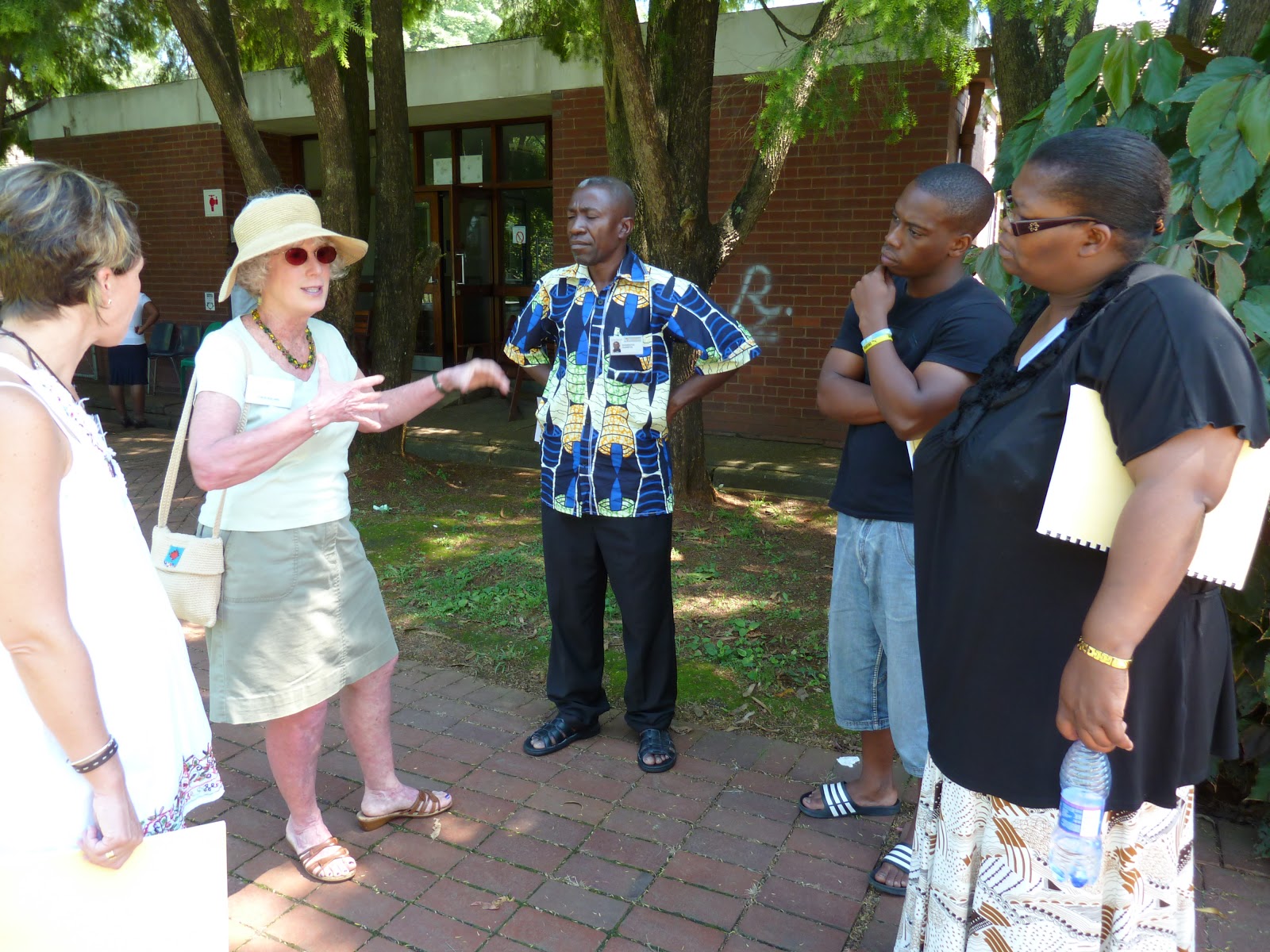
Above:  four seminarians volunteering at a school for the mentally challenged.

Note 2:   We will continue writing including when we get home and experience re-entry.

Monday, January 7, 2013

WRAP-UP PT II

by  Doug Roland


         South Africa is a simmering storm of frustrated, cynical, indignant, disappointed and angry South Africans of all colors. They are anything but united. 

Outside this storm lives a privileged class that has built a sort of economic stockade. They own very fine homes, command the business world and continue to accumulate wealth.  There is a TV series called "Top Billing" that spends an hour each week saturating the viewers with stories of the privileged, the beautiful people who live in 30,000 Sq.ft. homes overlooking the ocean.  We get to see their kitchens, their bedrooms, their horses, their artwork, their architects and their "fans".  These folks may as well be on another planet, so insulated they are.  

By contrast, most people live near or under the poverty level.  Many are losing hope.  Last week, a fire broke out in a shack settlement located in the shadow of South Africa's crown jewel and tourist magnet, Cape Town.  The fire spread in the brisk winds and left 4,000 people homeless.  

       The vision of a "rainbow nation" that delivers social justice, a better way of life, a color blind government, and the promise of  peace and prosperity is fading. The fabric holding the country together is splitting, leaving enclaves of discontent.  
        These problems arise out of a long, difficult history.  Millions of South Africans have lived lives of bare subsistence for generations. They are mostly simple folks, uneducated in basic life skills. Fellow Americans, deeply infused with the Protestant work ethic, would ask why black South Africans don't just work harder or get more training. It's a reasonable question in highly developed countries. Here, though, there is a series of deep ruts in the road the rainbow.  

These include a history of tribal conflicts that still remain. Several hundred years of colonialism took away the land of the indigenous people, followed by apartheid that broke their will.  Though the end of apartheid liberated black people in many ways, the ruts and the scars of their history have not healed. Very suddenly, black people were set free but without the knowhow or skills to survive in a growing industrial economy. 

For a couple of hundred years black Africans were ordered to do specific tasks, and only those tasks, leaving little room for improvisation, initiative or a sense of value as an individual. There was no reason to think big thoughts.  Consequently, showing initiative, going beyond what is required, and working hard to better oneself is rare.  For many, the "freedom" is an illusion. 
  
The government is looked to for answers, but few come.  The ANC was one of the main moving forces that brought apartheid to an end.  It has controlled the government since 1994.  However, many high ranking members of the ANC, along with favored contractors for government contracts, are now very wealthy while ordinary people have seen little evidence of a better life in a post-apartheid country. 

"The ANC leadership has failed to improve unemployment, housing, poverty and inequality during its 18 years at the helm of the South African government. To some extent the ANC, with its connections to big business, it's bloated salaries to party favorites and it's corruption in playing nice with friendly contractors, has become part of the establishment."  ("Rage By Miners Points to Shift in South Africa";  New York Times, Aug., 2012.)   

        Complicating this are cultural differences that stubbornly resist change.   Here's an example:

  Superstition exists even among our seminarians.  Just before exams last November,  some of them went  home to their own witch doctors or sangomas (local healers) for pieces of trees, plants roots, bark and other stuff. They came back to their apartments and boiled the concoction in water. He or she then created a sort of "tent" in which to breath in the steam.  It's a kind of Vick's Vapor Rub for improving the odds.  All this is done on the belief that it would help the seminarians be successful in their exams.  If you are wondering why people training for the Christian ministry would eschew prayer for this, so are we.  

Another roadblock is found in the Zulu culture.   A person who tries harder, goes the extra mile and improves his life, is not rewarded by his community. On the contrary he is considered disloyal because of the belief that all wealth should be shared equally. There are no honors for being outstanding.  Instead of individual thinking, we see a kind of "group-think".  As a result, individual responsibility is lacking.  All this, of course, ends in mediocrity.  It's a tough nut to crack.

What happens in South next is unpredictable.  Just how rigid are the traditional customs?  Can they be adapted to this century?  Will the people rise up and decry the corruption in all levels of government, or will they tacitly accept it as other African countries have?  

        After 18 years hopeful years of waiting to see how the new government would work out, most of our acquaintances are deeply troubled by the current state of affairs.  They have not yet given up even though the trajectory is not good.  Some have confessed that they already have an "exit strategy".   Others lack the resources to leave.

The level and frequency of problems has spawned a combination of defeatism, apathy and frustration.  This has serious implications outside of South Africa.  As the people continue to lose heart, the country is vulnerable to radical shifts such as demands to nationalize the mines and "taking back" the land of the ancestors.  If South Africa, Africa's most developed countryand the hope for the continent, begins to wane, it could trigger a domino effect. For the last 20-25 years, the neighboring countries have looked at South Africa as the model for the future. If it collapses, the other, smaller countries become vulnerable.  A new wave of economic colonialism could emerge, or other countries, fearing the worst, may pull out altogether.  

In my next piece, I will try to tie all this to what we have been doing these last months to help arrest and reverse the tide.  Recently, we've seen a couple of "green shoots" that might be a sign of correcting the course.

Friday, November 30, 2012

WRAP-UP Pt. I


by:   Doug Roland

  This post is the first step a series to sum up what we have found here, what we have done and what it means.  

I begin with a listing of incidents and problems that we have encountered during the 28 months we have lived here.  It is a compilation of observations that, in the aggregate, suggests that a social, moral and and political cancer is threatening the people of South Africa. 

        I am keenly aware that I am here by invitation, a foreigner, a temporary guest.  So the litany of items below are filtered by my own culture. It's risky business.  In the eyes of South Africans, this may be seen as alarmist, biased or unnecessary.  Nevertheless, I must be honest in recording what I have seen and experienced. 

For my friends back home, the intention is to share a sense of what it is like to be here day in and day out.  It may help make it clearer if, after you read this, you try to imagine what it would be like if you were here.  How would you act and think?  How would you feel?

 
**********************


Things seen, read, heard or experienced:

  •   frequent power outages and water main breaks
  • the solid waste pickup takes one vehicle, the driver, and about four others 
  • a deep hole in the sidewalk, large enough to swallow a small child, resulted from the repair of a water main break; the hole remains 5-6 weeks later 
  • about 20 yards from the hole is a street named "hores", or at least it was 2 years ago;  recently the sign was repainted, "Shores";  glad they cleared that up
  • potholes in our street are not fixed for 3-4 months
  • robots (stop lights) go out regularly, usually during rush hour
  • police investigation of the burglary at our house last February; a promise from the Captain to send a fingerprint team.  The prints remain on the wall; the team never showed
  • car accidents near us, glass and debris on the road is swept into a pile and left
  • street lights on our street and a street nearby have been out more than on in our 28 months
  • there are high schools with libraries of empty shelves; but, outside there are athletic fields sufficient to accommodate soccer, cricket, track and others;  most have competition level swimming pools, including primary schools
  • the nearby university has built separate clubhouses for rugby, field hockey, cricket;  and an array of outdoor lighting for the fields even when no one is there (these lights seem to always work)
  • proportionately more Mercedes and  BMWs than I see on Florida roads;  this in a country of  27% unemployment
  • a trip or phone call to any public office is often depressing due to employee incompetence and dreadfully slow pace;    

Recent stories from the evening news:


       miners go on strike, express their demands by marching, singing, shouting slogans;  police open fire, killing 31 miners.  200 police are involved

    wildcat strikes have broken out in mines and agricultural areas; strikers sing, march and dance;  demanding up to twice existing salaries

       a platinum miners demanded equal pay for all the regular miners regardless of skill, years with company, absences;  also demanded that the job of foreman be eliminated, i.e., no bosses

         nearly every newscast begins with 100's of strikers, their, families, friends and hangers-on demonstrating for their causes; it has been said that this country is the only place where people express their anger by singing

  the economy's growth estimates are adjusted downward;  the value of the country's currency has dropped during these strikes

       a school has one bus to pick up students;  it's either late, broken or doesn't show up at all

     5-6 children ride to school in the back of a pickup truck as parents have no other way to get them there;  truck crashed into another vehicle;  all children were killed

       an adult was carrying three young children to school in his car did not arrive;  children found dead, including a girl who was raped 

     in a protest against failure of the government to provide help to a poor community, parents kept their children from going to school  (think about that)

       in one of the provinces, a supplier failed for over 10 months to deliver books to schools; one truckload was found along the roadside, simply dumped; investigation continues

        a week ago a 12 seat van belonging to the seminary was stolen from within the seminary's  apartment complex secured by metal fences 

      some universities lower their academic standards because of unprepared students;who can't cope; otherwise, if students are failed, there would not be enough to remain open;  in short, institutional dumbing-down

  •   there is a constitutional right to a college education;  last January
  • thousands of hopeful students en mass tried to get into one of the
  • universities that could not accommodate even a fraction of them;  a riot ensued
     
        the president of the country is a grade school dropout;  he  approved a project to "improve" his personal home for himself and his several wives at a cost of about $25 million of taxpayers money;  the home is in a far rural area;  the president answered the critics by saying that the millions were being spent because of security issues; [Note: it is not an "official residence" that would qualify for security as a government expense.]
  • the ANC (African National Congress) has been the dominant
  • political party in the country since the end of apartheid and has
  • commanded about 2/3 of the electorate; every province in the country,
  • save one, is governed by the ANC
  • the president has had some setbacks from the Constitutional Court. 
  • He is fighting a movement from critics to hold a vote of confidence. Fearing the Court, the president has called for a return to the "Traditional African Court" way of doing things, thereby showing an indifference to the rule of law.

*******************************************************************

        Folks back home, I think  you should be very thankful. 

Wednesday, November 21, 2012

WHAT'S GOIN' ON

BY:  Cheri Roland


Dearest Family and Family,
         Guess you might have thought we had vanished!  But, no, this is crunch time when working in an almost new institution with a whole world of God possibilities just waiting to be tried on.  “Exciting” would be a gross understatement.
         First we need to thank the United Methodist General Board of Global Missions for developing a dynamite internship program for budding ministers.  Hillary Taylor, a new Furman University grad, came to us a month ago courtesy of GBGM, as a 14 month volunteer to SMMS, after which she will serve another 18 months in mission stateside.   We are grooming her to take over the reins of the practical ministry course, FEM, when we bid adieu in 2013 on April Fool’s Day.  Maybe a message there…
         Finishing the academic year comes with challenges of its own, as all of you teachers will appreciate.  The flurry of assignments, final exams, marking, averaging, avenging!!!  Just kidding…   A major mission for us, exclusive to our course, has been tracking down evaluations written by our partner agencies on individual seminarians.  OH the trauma and gnashing of teeth around typical TIA (This Is Africa) complications - no copier, the weather, no way to bring them, no one there when we go to pick them up, having not even begun to fill them out when we arrive at the agreed upon time, no email access because the power lines have been stolen (to get the copper)…  We also have helped with invigilating, or monitoring, exams.  And all this must be done allowing time for those who have failed an exam to take “supplementaries” (for students who have failed).  Our valedictory service closes out the year this Saturday.   We staff members then work through December 14th.
         But the MOST exciting project now is the makeover of our FEM program.  It all began with a visit by Dr. Mark Fowler from Garrett Theological Seminary in Chicago, a friend of Pete Grassow.  Pete is our Chaplin and new Head of Formation, under which FEM falls.   Anyway, Mark came this past winter (Tampa’s summer) to review our FEM course; his speciality is practical ministry, so who better to help expand our vision?  He was full of praise for what Doug and I had put in place, saying our program rivalled those of many seminaries in the States.  What he saw missing was integration into the academic side of seminary life.  We wholeheartedly agreed.  Our meager attempts to link with our lecturers had fizzled, often because of the existing seminary structure.
         The renowned Dr. Peter Storey to the rescue!   He has been our interim president and most excellent backdoor neighbour when in visiting in Pietermaritzburg.   Dr. Storey has redefined our internal structure to compliment a just birthed revolutionary seminarian assessment tool.  This is so new that MCSA General Council hasn’t even voted on it yet!  The idea is to evaluate the person called to ministry using the same criteria from day one till ordination seven years later.   We can’t wait to try it out!   No longer will the three years at SMMS viewed as a separate and sacred time block not to be messed with by EMMU bishops peering down from their thrones.  No, now we are all one big happy family, thanks to Ross Olivier, his son Jon-Mark, and Peter Storey expanding horizons.  Yes, there have been hands of reconciliation across the water.  
         With this fortuitous  rethink, FEM will indeed to join the rank of an honest-to-goodness academic class – and get this – will be taught by none other than our new seminary pres, Dr. Mvume Dandala!  Take about instant clout .   One week will be classroom time, and the next, their agency visits to apply what they are learning.  SMMS offers both a Diploma in Practical Ministry and a Bachelor of Theology, with year one providing the foundation for following in Jesus’ footsteps, year two focuses on deepening  servanthood and year three culminates in leadership training.  
         So all of these changes have necessitated ferretting out NEW agencies to partner with SMMS in this adventure.  I’m sure you all are OK with CHANGE, but it’s still a six letter word for me.   My gut reaction was to circle the wagons around the program we had built – but how silly is that?!   This overturning of the apple cart – forgive my mixed metaphors – has actually knocked out the rotten air, making room for revitalization and exploration of other wonderful agencies in our area who are doing amazing work for the Lord.  And, shock of ages, they are not all Methodist…
         Hillary has come to the fore to shake up our in-the-box-thinking (see the need for our blog’s name?), and with her enthusiasm will propel this program to new heights.  She will be the official coordinator, linking the agencies with the lecturers.  And get this!  Our new accountant and his wife from Malawi -- who knew they both have a Masters in Practical Ministry?  Yet another God thing!  So they have been recruited as adjunct lecturers for FEM. This classroom experience will also offer a fabulous venue for our agency staff members to share their stories and expertise as well as greatly increase seminarians’ exposure to issues at the intersecton of ethnicity, church and society .
         SOOO, as you can tell, we have tons and tons to be thankful for this Thanksgiving.  Although we are soon closing this indescribable chapter in our lives, our hearts are bursting with joy as we birth a new era of FEM, secure that our call to work with future ministers has been taken up by others.  This seminary will continue to bear fruit!  And, in that spirit we are celebrating Thanksgiving Thursday with real turkey and stuffing and pie and the rest.  Hillary from South Carolina, Wilhelmina and Rodrick from Jamaica, Frenchey from Mississippi, and Nellie and Rob from Holland are converging on #7 Isabel Beardmore to keep up the American tradition of over indulgence alive and well.  And you all will be in our hearts and minds as we praise the Lord for his providence and love.
Blessings for an awesome Happy Thanksgiving,
          Cheri

Thursday, September 13, 2012

A SHRINKY DINK WORLD

By:   Cheri Roland


Ah!  Shrinky Dinks…  One must be of a certain vintage to remember those large, brightly colored plastic sheets which, when heated in the oven, shrank to small hard play objects.  Google informed me they first were sold in Brookfield, WS in October, 1973.  I used to love watching their magical transformation from a big nothing down to miniature objects.  Events of the past several days have brought to mind how interconnected we all are, a shrinky dink world, and so ripe with serendipity.  
Friday evening I was chatting with a neighbour over the fence.  Pat had just returned from three weeks in the US, visiting their daughter in Columbus, OH.   What a coincidence!   I told her  that’s where my grandma and aunt had lived, is just two hours north of where I grew up in Middletown, and one hour south of Ohio Wesleyan where my dad and I had gone to college.  Then Pat added that she finished her journey in Nashville.  
“Nashville?  Samie, our daughter-in-law, and granddaughter just moved there!  She is doing a fellowship in pediatric ophthalmology at Vanderbuilt.”
“Well, I was visiting our son-in-law’s mom, Tamie Wallace, who just moved there to work in the children’s hospital in the NICU!”
So a half a world away, our Samie will be operating on tiny patients, then transferring them to Tamie’s care.  Both women are linked to a little street, in a little town, in SA.  Shrinky dink.
Saturday afternoon was lovely, the first warm, sunny day in a week.   While the hadidas buzzed the house, we enjoyed sitting on our patio, Skyping with son Nat and baby Clara, almost three now.   Coming out the back door to join Doug, I heard Clara’s joyous squeals at seeing her Grandpa D’s face.  Merrily chatting away, she immediately showed us her new baby carriage, a gift from Samie’s parents.  Then she pointed to a big surprise.   Against a wall was MY light blue doll crib that my daddy had made 60 years ago!  I couldn’t believe my eyes!  Immediately memories flooded up of the cosy, bright workroom in the basement where my sisters and I would “help” Daddy measure, saw, and nail together our toys.  It always smelled of sawdust.   I can still hear the scroll saw.  How on earth…?  It turns out that when my parents moved from Middletown, they sold this crib to our neighbour playmate, Cheryl Fassler.  Cheryl became a doctor and settled in Nashville, where she is now head of Hand Surgery at Vanderbilt University.  When Samie found out she had matched at Vanderbilt, we put Nat and Samie in touch with Cheryl; they have become good friends.  Cheryl’s adopted Chinese daughter, Emily, is thirteen now, too grown-up to play with dolls.  So Cheryl gave Clara the famous crib.  It has re-joined the family!  Yesterday at breakfast we hooted over a picture Nat had sent of Emily and Clara, two beautiful Asian girls, one big and one little, at the fair, petting a pig.  Shrinky dink. 
It seems every way I turn here, I bump up against the cultural practices of witchcraft and ancestor worship.   The neighborhood just around the corner from us is primarily Indian, and many homes employ black gardeners and maids.  I had become curious about small piles of burned multi-colored “stuff” littering the pavement in front of some driveways.    So a few months back I approached two workers as they were leaving for the day.   I greeted them and pointed to the charred remains at my feet.  “I’m an American visitor and wonder if you could tell me what this is.”   The two exchanged a meaningful look.  One answered, “Oh, those are burned to bring the house good luck.”  The other said something in Zulu.  “What do they burn?” I asked.  The first reiterated, “Yes, it is for good luck. You can have it made special, or buy bags ready- made.”   My suspicions were confirmed.  Definitely more witch doctor stuff…
This Monday afternoon I was walking as usual with our Jamaican neighbour, Wilhelmina.  She and I make a strange sight – she is black, tall and thin, and I’m white, short and fat.  Often Zulus will pass us and start talking to her; of course she has no clue what they are saying.  We giggle, and I  tell her she must learn how to say “I don’t speak Zulu” in Zulu.  She and her husband also arrived in 2010 as missionaries serving three years in Maritzburg, but we only had found each other after six lonely months, a mere 15 houses apart.   Can you say “shrinky dink”?  She talks as much as I do, and we hit it off right away.
So, chatting non-stop, as we climbed another long hill, an Indian gentleman hailed us.  He pointed to the stunning burgundy bougainvillea; we finally figured out he was asking if it would root from a snapped off branch.  (Yes, in shrinky dink fashion SA has tons of the same plants we have at home!)  Ala Charlton Heston, at his feet laid a long spiral animal horn.   I had to ask!  “ A shofar.  I use it to chase away demons.” 
Demons!  Of course my ears perked up.  Our Indian friend went on to say he is a prophet, a son of God, and uses the shofar for protection against evil.  Then he launched into quoting Old Testament scripture passages about fearing the Lord because He can kill you twice, once physically, and then kill your soul and send you to eternal damnation in Hell.  We listened, nodding in a PC kind of way.  When he came up for air, I asked if he would demonstrate the shofar for us.  He hesitated, then dramatically hoisting the ram’s horn, struck a pose just like Moses in the movies.  Taking a mighty breath, he pursed his lips and belted out a deafening blast, sending the neighbourhood guard dogs into apoplexy.   My ears were ringing.  Wilhel quickly thanked him and grabbing my arm, propelled us up the hill before I lost it.
To get the pic for this blog, yesterday Wilhel and I, armed with camera, took the same route.  Just at the top of the long hill, past the Italian prisoner of war chapel Doug wrote about some time ago, I noticed a white haired white guy clad in Lycra biking shorts, in great shape I might add, entering his gate with his bike.  He looked safe.  Here was our photographer!  I ran up and quickly enlisted his assistance.  When I explained about the little charred piles “for good luck” he chortled, “Good luck? HA HA!  You told you that?”  We all had a good laugh.  “First of all, there is no such thing as good luck.  It’s the grace of Jesus Christ the Almighty.  Secondly, this stuff is witch craft.”  He teaches Extreme Sports at Epworth, the prestigious Methodist school next to the seminary.   Shrinky dink.
What a rich tapestry of interwoven relationships envelope us!  There are fascinating characters everywhere, not just in Tampa before a presidential election.   And to think we have all been put on this amazing, God-given shrinky dink world together!


Tuesday, September 4, 2012

THE GOLDEN RULE RULES?

by Cheri Roland


The longer we are here, the more this feels like the norm.   Why, we’re almost natives.  But then something will happen that points out just how naïve we are.  

Each semester, Doug and I put together the field education workbooks used by the seminarians to record their reactions and insights as they volunteer in the community.  We choose a theme, and pick scripture passages which are cornerstones of the Christian faith.   My favourite part of this gig is reading the seminarians’ reflections.  It is such a privilege peek into their world as they face new people and situations.
Writing the reflections is not intuitive for our students.  They were never encouraged to journal in school and many who are called to the ministry have never read the Bible.  (Not too unlike the US…) But they have had pastors scream scripture passages at them.  Part of our mission is to empower seminarians to live with scripture, to seek understanding with new eyes and minds.  What does this passage mean for my life?   
This semester the theme is “transforming challenges into opportunities”.    Our current assignment featured Luke 6:31, the Golden Rule, where Jesus says we are to treat others the way we would want them to treat us.   One of the assigned questions was, “What part of this passage is most difficult for me to put into action?”  The majority of responses went something like, “Making the other person do what I want him to”.  My initial reaction was, “EISH, how could they get it backwards?”    Then it hit me - my cultural blinders are back on again!    Obviously something has made them interpret this from the other side.
As I was wondering what could do a 180 on the Golden Rule, Jenny, one of our English teachers, shared with me what she had just learned from her Zulu languagestudents during a class discussion.  In many of the traditional black cultures, like Asian cultures, a new wife becomes property of the husband’s family.   Usually this set us a competition between in-laws, a struggle that has played out for generations.
Here’s the example the students gave to Jenny:  After dinner the husband decides to help his wife by washing the dishes.  Mother-in-law immediately pounces on daughter-in-law.  “You laid a spell on him! What did you put in his food? “  (Since mother did not rear him to wash dishes, it must be witchcraft.)   Jenny asked if this animosity was present in Christian homes; her students assured her, “Oh, yes, even high up Christians, like bishops.”   Of course a toxic home atmosphere poisons all within the family, and colors the understanding of scripture.
Survival of the fittest was the order of the day before Jesus came with His revolutionary message.  It still is seen in the traditional belief that there is a finite cloud of resources available to any given group, and each member is entitled to an equal share.  When the group sees someone that has become more successful than others, it means he has used more than his rightful share of resources, thereby stealing from everyone else.  He must be punished and the evidence of his success, removed.  Because of this belief, people are actually driven out of their communities, contributing to unemployment, homelessness and poverty.   The destruction rent by this tradition effectively reduces the tribe, village, or community to the lowest common denominator.
For centuries it has been said that the measure of civilization/society is how they treat their weakest members.   We’ve told you about the seminary’s partner agencies who serve as refuges for the children who have been thrown away here.   Their disabilities are viewed as evidence of displeased ancestors.  Parents go to great expense to “fix” them, often resorting to witch doctors that use unspeakable “muti” to appease these ancestors.  Every semester our reflection questions ask the students assigned to these orphanages to discuss the causes and prevention of such abuse.  But they will rarely address these issues that cry out for justice.
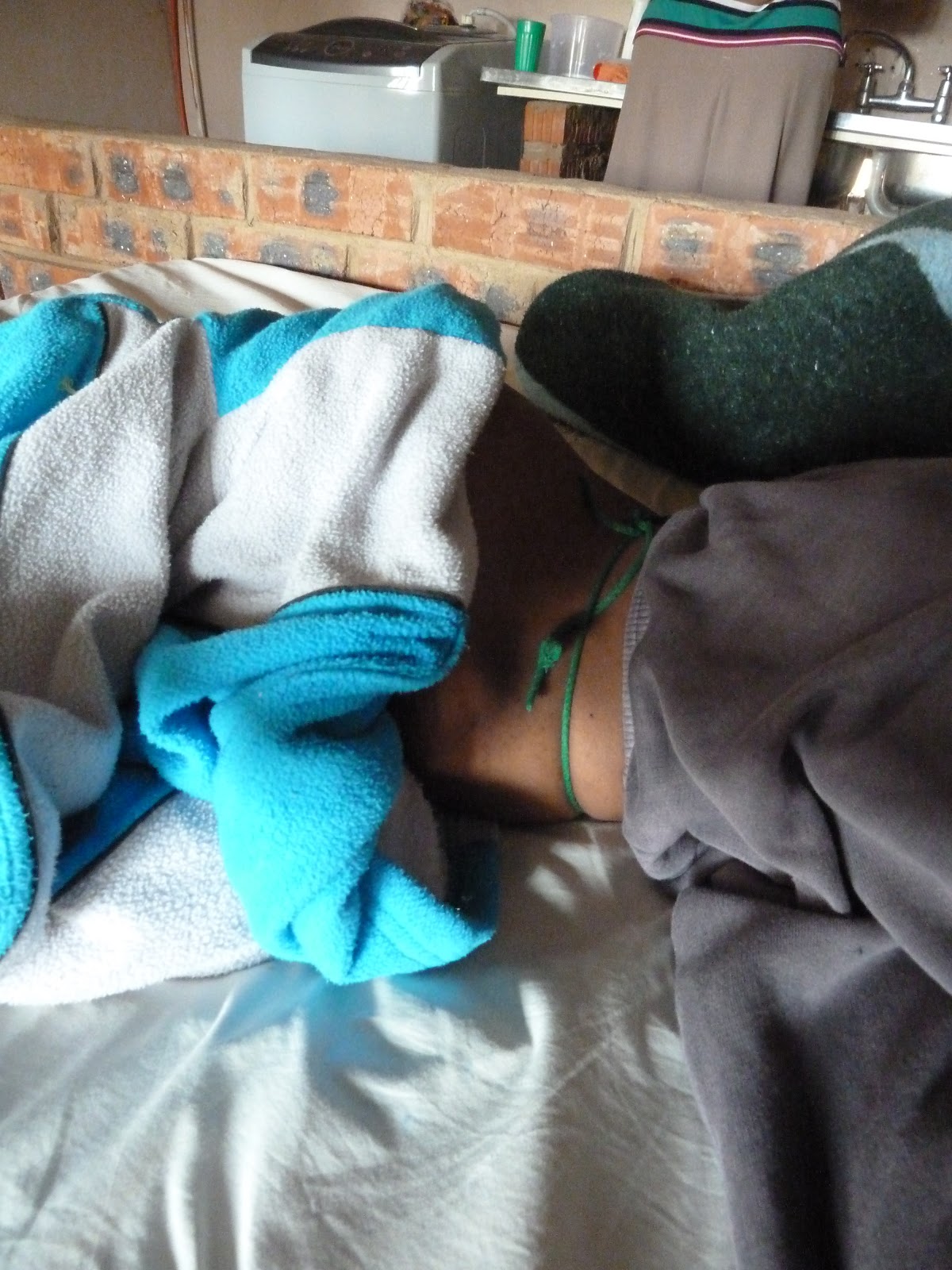
Two weeks ago I went to White Cross Disabled Hope Centre with the group.  We were happily greeted by several of the more mobile kids who led us outside to play.  There is always a mattress on the ground with scattered lumps of little people under blankets who have been rendered quadriplegic; they lie all day at the caregivers’ feet as the others sit or hop around them.  Siphiwe, just a little guy, was lying on his side, his eyelids fluttering over a vacant stare.  His upper body was developed but his waist and lower body were pitifully atrophied.   Although he is the size of a toddler, I was shocked to learn he is ten years old.  He had just returned from a home visit over the weekend.   Stewart, founder of this agency, lifted Siphiwe’s shirt to show me a traditional ancestors’ green cord that had been tied around his waist.  I asked why it wasn’t removed.  Our own seminarians quickly assured me, “You can’t take it off!  That is to ensure the ancestors give good prayers.”  I shuddered.  This is deeply imbedded stuff.  In ancestor worship, Jesus is still just one of the boys.
No wonder seminarians have a hard time with the Golden Rule.  No wonder the mission of SMMS is “Forming transforming leaders for church and nation.”  As our late president Ross used to say, the very future of this continent is at stake. 

Sunday, September 2, 2012

NEWS: HOME AND ABROAD


by Doug Roland

29 August, 2012
Pietermaritzburg, South Africa

The last three days have reminded me why we are here.  Things have happened that are unfortunately common and rarely get any media attention.  Here, they are daily, routine events. Back home the news is about a hurricane and the RNC convention in our hometown resulting in:  massive media coverage, blocked streets, cops everywhere, discreet visits to the shadier bars and clubs, parties, millions being spent by delegates, the obligatory volumes of hot air, balloons and confetti.    To me the contrast between those events and what follows is blinding.

Regular readers know that the centerpiece of our job is managing the field education program at the seminary.  It involves sending seminarians to a number of non-profits where they volunteer and, in the process, develop both practical ministerial skills and an appreciation of the communities that pervade this country.  Monday and Tuesday, we visited three of our field education partners where these tasks take place. 

Monday   Up a long, winding road at the edge of town we come to a project named "Walk in the Light."  It is a small beacon of hope to the mostly wretched township of Haniville.  Homes are made from whatever materials someone can afford.  Some are solid concrete, stuccoed and painted brightly.  Others are made from corrugated metal sheets. Still others are mud.  The water pipes in Haniville are broken. Tank trucks drive through the broken streets to fill the pales, buckets and jars that people bring. The ill, elder and lames have to rely on others to bring water to them.  In many houses electricity is non-existent or stolen.  

We joined the non-profit partner and three seminarians to visit a shut-in. The house sits up the steep rocky slope from dirt road.  It is made of mud,  stones, and a metal roof with major leaks. As we waited outside in the bright sunshine for the invitation to enter, we could see nothing in the small dark interior of the house. It looked more like a cave than a 21st century home. 

Soon after, the six of us filed in where we met Frank who was sitting on a sunken couch. Frank and his sister occupy the house though she was not there. The one room home was divided by a ragged sheet hung on a thin wire.  Frank spoke only in whispers and gestures.  He had suffered a recent stroke that affected his left side.  The visit had been pre-arranged and he looked at all of us.  After some discussion about his condition,  a seminarian and Cheri teamed up to bridge the language/cultural barrier in an effort to help him. They demonstrated some basics tips on how to restore movement in his left side by lifting his left leg, massaging his hands, manipulating his arm and the like.  Frank concentrated on these angels of mercy. His face, though frozen by paralysis, changed from fully neutral to a faint gleam of excitement in his glistening dark eyes.  He understood that he was being helped to restore his health, and that there was, after all, something he could do to help himself. It was a powerful example of bringing hope to a person in need.  Sure, he wasn't cured.  He might never be.  But he'll remember the day that perfect strangers came to him with good news.

A seminarian then prayed in Frank's language.  Another wanted to sing and we joined in.  Frank sat quietly but undoubtedly was singing in his heart.  
Tuesday.

We drove downtown to a another project named Tabitha House.  It's a large orphanage.  We were told that two of its staff members had died over the weekend from an outbreak of meningitis in a nearby, densely populated township.  42 residents also died. There may be more.  Some simple hygiene could have saved lives.  Nothing appeared in the press.

From there we made a short trip to Key Ministries.  It is a program for an estimated 3,000 refugees residing in Pietermaritzburg.  Key was founded by Pastor Sampson, a refugee from Burundi.  It is his passion to minister to this population.  He feeds himself and his family by making African shirts.  We are the proud owners of two of them.  There is a dribble of outside support. 

Two of our seminarians are stationed there daily to assist him. Others come later in the week. Key's office is but a few blocks from where many of the refugees live. 

South Africa is seen from many other countries on the continent as a wealthy country, a place where a person can build a new life and raise a family. They are hampered mostly by three issues  First, many of the bureaucracies in this country are heavy laden with rules, and staff who can't read them.  As a consequence, it can take several years to get a work permit, and that's if you are diligent.  Then there's the catch 22 - employers are reluctant to hire.  Xenophobia has not gone away and is embedded in the poor South African communities.  Hate groups intimidate anyone who wants to help the refugees.  Potential employers are reluctant to hire even a qualified and documented refugee.  We were shown a "hate" document threatening reprisal to any agency or employer who helps refugees.  It was e-mailed to Pastor Sampson and is a real concern.

The refugees have found "housing"  in dilapidated, formerly genteel, buildings.  We visited two families from the DRC (Democratic Republic of the Congo.)  At the first house we met a man, his wife and one of his 7 children.  The father had been a manager of a hospital back home. The family tries to survive by selling candy on the sidewalk. They stay in one room about 9'x9' , the size of a nice walk-in closet. They were very gracious and we enjoyed using the few French words we know.  It was a very nice time for us.  Soon we left and the family returned to the small dark room not knowing what the next day might bring. 

The other family consisted of an HIV+ mother of four whose husband died of AIDS while refusing ARV treatment.  The baby is about 3 weeks old.  There is fifth child of the father in the household, but via a different woman.  

Their apartment is reached from an alley, then an ascent of three floors on paint-spatters steps.  There were no lights and we heard no people.   At the top, we entered a crowded  passageway about 5 feet in width that acts as a kitchen:  one or two pots, a pan, a pan for water, a hot plate.  A few food items on the floor. The "apartment" was the remnant of a much larger room subdivided by a badly cut drywall.  There was a small bed and one double.  All this for about $350/month.  

The mother and baby were bundled on the double.  She did not speak.  So, Pastor Sampson told us her story, how the family fled from the DRC to South Africa for safety and their hope for better days.  As he spoke tears trickled down his face.  She was his first client, and he remains the only spiritual support she has.  For Pastor Sampson, she is a vital reminder that it always starts with one person. It sustains him in his struggling mission, the only one of its kind in the city.  

We, as a seminary, have loaned seminaries to assist him in whatever way they can by helping with administrative matters, document review and expanding the all-important visits to this immigrant population.   


Wednesday.

Last week, Thursday through Sunday, about 50 seminarians went north to minister to families and individuals in remote, rural places.  It's part of an annual program.  Seminarians stay in homes as available.    The time is spent in visiting homes of the needy, the aged, the sick.  Worship and healing services are conducted in the evenings.  Cheri and I did this the first year we were here.  While it was very strange to us, we are very glad we did it.

This morning, seminarians who had attended the event this year announced in chapel that, sometime during the last few days, his hostess from the weekend was found dead, having been raped and decapitated.  Her name was Andile.  

As I alluded above, there are few if any outcries when "small" things like these happen.  Judging from what we see on TV, mass outrage is reserved for the government, labor strikes and powerful political factions.  The rest is considered the norm.    

It is through these experiences that we challenge the seminarians to place them in biblical contexts, to exercise transformative techniques, to literally be Christ's hands and feet, and to speak the truth to injustice. 

As we enter our last few months here, we are compelled personally to ask what it all means and how do we reconcile this with to living back in our little paradise called Davis Islands.  Where would you start?